
What Fits in a 1-Liter Hip Pack?

A 1-liter hip pack can plausibly carry a phone in its case, a slim wallet, a small key set, earbuds, and lip balm. Fit depends on the pack’s shape and your items’ dimensions. Bulky extras, especially sunglasses cases and water bottles, can crowd out essentials or make the bag awkward to close.
What does 1 liter mean for a hip pack?
One liter equals 1,000 cubic centimeters of volume: the same volume as a cube measuring 10 centimeters on each side. A hip pack spreads that space into a different shape. NIST’s volume guide explains the conversion.
The capacity label does not guarantee room for a 1-liter water bottle. That bottle needs space for its walls, cap, and shape as well as the water inside.
External measurements also differ from usable compartment dimensions. Padding, seams, dividers, curved corners, and pocket layout affect where objects can sit. A long item might fit inside the compartment but struggle to pass through its zipper opening.
For example, Patagonia lists its Terravia Mini Hip Pack as 1L, with dimensions of 8 × 2 × 4.5 inches, a zippered main compartment, and a zippered front security pocket. Those specifications describe the bag; they do not establish which combination of your belongings will fit. Patagonia product specifications
What fits in a 1-liter hip pack?
Use this table to identify likely packing candidates and the items that deserve measurement. These are illustrative fit expectations, not physical test results. An item fitting individually does not mean every item below fits together.
Item | Size or form-factor caveat | Effect on remaining room |
Phone with its case | Measure the case, including grips, loops, or attachments; check pocket and zipper dimensions. | Uses a broad, flat area that could otherwise hold a passport or wallet. |
Slim wallet | A cardholder is easier to accommodate than a thick, coin-filled wallet. | Keeps more depth available for small accessories. |
Keys | A few keys differ substantially from several fobs and a large keychain. | Can fill gaps, but bulky fobs compete with earbuds or sanitizer. |
Earbuds | Include the charging case when assessing size. | Adds a rigid object that needs its own space. |
Lip balm | A narrow tube is easier to place than a large pot. | Can use a small gap or organizer pocket. |
Small sanitizer | Measure the whole container; a squat bottle or clipped-on holder adds bulk. | Competes with earbuds, keys, or snack space. |
Snack | A flat bar is easier to arrange than a bulky snack pouch. | May fit against a panel, but can be crushed in a tight load. |
Sunglasses | Folded frames, soft sleeves, and hard cases have different space needs. | A hard case can become the main bulky item; a sleeve offers less crush protection. |
Passport | Check its dimensions with any cover or travel wallet attached. | Uses flat space and needs access without bending. |
Compact power bank | Check length, width, thickness, and the charging cable. | Adds both bulk and weight; may replace another accessory. |
The useful question about 1L hip pack capacity is whether your complete load fits with enough room to retrieve things easily.

Three illustrative packing combinations
The following loads are starting points for a fit check. None has been physically tested, and each assumes compact items.
Everyday errands: keep the accessories small
Illustrative contents: Phone with a slim case, cardholder, small key set, earbuds in their charging case, and lip balm.
Space tradeoff: This load prioritizes daily essentials. A large car fob or phone grip could use the space intended for earbuds. Adding sanitizer may require removing an accessory.
Consider a larger bag when: You also need a full wallet, glasses in a hard case, or a charger and cable without rearranging everything.
Sightseeing: prioritize documents and phone access
Illustrative contents: Phone with a slim case, passport without a bulky cover, cardholder, one room key, and a small sanitizer container.
Space tradeoff: The phone and passport both need broad, flat space. Pocket layout determines whether they can sit separately and remain easy to reach. This example leaves sunglasses, snacks, and a power bank out of the bag.
Consider a larger bag when: You need those extras together, several passports, or a substantial travel wallet. Choose space around your actual travel documents rather than the capacity label alone.
Short neighborhood walk: make room for one snack
Illustrative contents: Phone with a slim case, one house key, cardholder, lip balm, and a flat snack bar.
Space tradeoff: Leaving out earbuds and sanitizer gives the snack a better chance of fitting without compression. Sunglasses are worn or carried separately in this example.
Consider a larger bag when: You need to carry water, a layer, or additional supplies. This is a neighborhood carry example, not an equipment list for a remote hike.
Which items need a closer fit check?
Large phones and bulky wallets
A large phone may fit the main compartment but fail to fit an organizer sleeve. Measure it with the case attached and allow clearance for inserting and removing it.
A thick wallet can also push other items outward. Try the phone and wallet together early: their combined thickness may matter more than either item’s individual fit.
Sunglasses and hard cases
Measure the closed hard case, not just the folded glasses. Its rigid shape limits how other objects can nest around it.
A soft sleeve reduces bulk but provides less crush protection. If a hard case is essential, treat it as a priority item and build the remaining load around it.
Water bottles
Check a bottle’s length, diameter, and cap against the actual compartment and opening. A small bottle or soft flask may work in some designs, but its fit alongside essentials requires a separate trial.
External bottle holders are a different arrangement from internal storage. Trail Utility, for example, lists two zip-out bottle pockets on its 1L Hip Pack. That feature does not establish bottle compatibility for other 1-liter bags. Trail Utility product details
Packable layers
“Packable” does not describe a fixed packed size. Measure your layer in its pouch or intended folded shape.
A thin wind shell might be a candidate in some designs, but check it alongside the rest of your load. If the layer occupies most of the compartment, a larger bag may be more practical.
How to check your own packing list
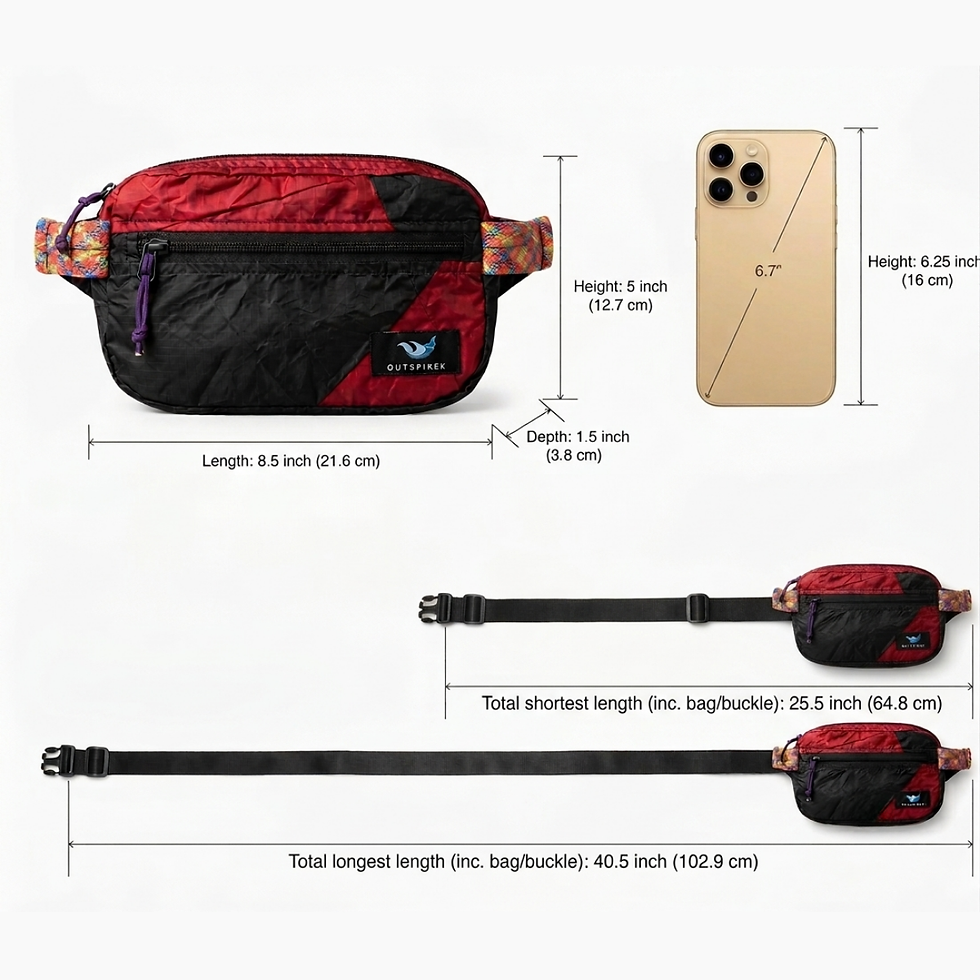
Gather the complete load. Include phone cases, passport covers, charging cables, key fobs, and protective cases.
Measure the largest rigid items. Record length, width, and thickness, including protruding attachments.
Check compartment dimensions. Ask for usable internal measurements when only external dimensions are published. Confirm which pocket must hold each large item.
Check zipper access. An object needs to pass through the opening as well as sit inside. A cardboard outline can help screen flat-item dimensions, but cannot prove combined fit.
Try everything together. Pack the largest items first, then place smaller pieces in available gaps or suitable pockets.
Close, retrieve, and wear. Zip the bag, take out your phone and wallet, repack them, and walk with the loaded bag.
A comfortable fit means easy closure without forcing the zipper, practical access, and comfortable wear. If retrieving your phone means unloading half the bag, the load needs adjusting even if it technically fits.
When should you choose 2 liters or more?
Consider 2 liters or more when your essentials regularly include several bulky items, such as a hard glasses case, power bank, full wallet, bottle, or packed layer.
A 2-liter bag has twice the stated volume of a 1-liter bag, but shape and organization still determine what fits. Extra space can simplify access; it also means a larger bag against your body. Check bottle and layer compatibility independently.
FAQs
Will my phone fit in a 1-liter hip pack?
It may. Compare your phone’s dimensions with its case attached against the intended compartment and zipper opening. Then check it with your other essentials.
Can a 1-liter hip pack hold a water bottle?
Some designs may accommodate a small bottle internally or provide an external holder. Check bottle dimensions and remaining storage; a 1L capacity label does not promise room for a 1-liter bottle.
Does a passport fit in a 1-liter fanny pack?
A passport is a plausible flat-item candidate when the compartment and opening are large enough. A cover, travel wallet, or multiple passports changes the fit.
Is a 1-liter hip pack big enough for daily use?
It can be if your daily carry is compact and passes the closure, access, and comfort checks. Bulky accessories make a larger small waist pack worth considering.
Should I choose a 1L or 2L hip pack?
Choose 1L when your complete load fits comfortably. Consider 2L when you need additional bulky items or more room to retrieve essentials; confirm the larger bag’s dimensions too.
Choose the size around your actual carry list
A 1-liter hip pack is a sensible candidate for compact essentials. Try your complete load, including every case and cover. If it closes easily, lets you retrieve essentials, and feels comfortable while walking, 1L meets your needs. If a required item makes packing awkward, compare a larger size.


